How to walk 10,000 steps a day with Better

On this page
10,000 steps a day is easier to keep when the tracking is automatic. Better can sync steps from Apple Health, show the day’s count, and keep your walking habit on the same grid as the rest of your challenge. You still need a realistic plan: split the walks, choose a busy-day minimum, and check the number before the day disappears.
Walking is simple. Tracking it should be simple too.
That is the appeal of a 10,000-step goal. It turns movement into one clear daily number. You do not have to decide whether the walk was “enough.” You can see it.
The problem is what happens around the number. You forget to check until bedtime. You assume you walked more than you did. A busy day turns into 3,842 steps and a small argument with yourself about whether that should count.
Better helps by making the walking rule visible. If you use Apple Health, Better can sync your steps automatically, show the current count, and keep the result on a habit grid. The app does not take the walk for you. It removes the manual part that makes a step habit easy to lose.
Start with a clear walking rule
“Walk more” is too easy to ignore. “10,000 steps a day” is better because it has an answer.
Still, 10,000 steps is a target, not a personality test. It can be a strong goal for many people because it is high enough to require intention and simple enough to track. It is not a magic number. If you currently average 3,000 steps, starting with 6,000 may be the smarter first challenge.
The useful question is not whether 10,000 is perfect. The useful question is whether the number makes you move more consistently without turning the whole day into a negotiation.
Let Better sync the steps for you
A step habit gets annoying when it becomes another manual habit.
Better can connect to Apple Health and use your daily step count as the rule. In Health Sync, Steps sits under Activity & Movement next to walking and running distance, exercise minutes, flights climbed, and stand hours. Once steps are connected, Better can show the day’s step count without you typing the number in by hand.
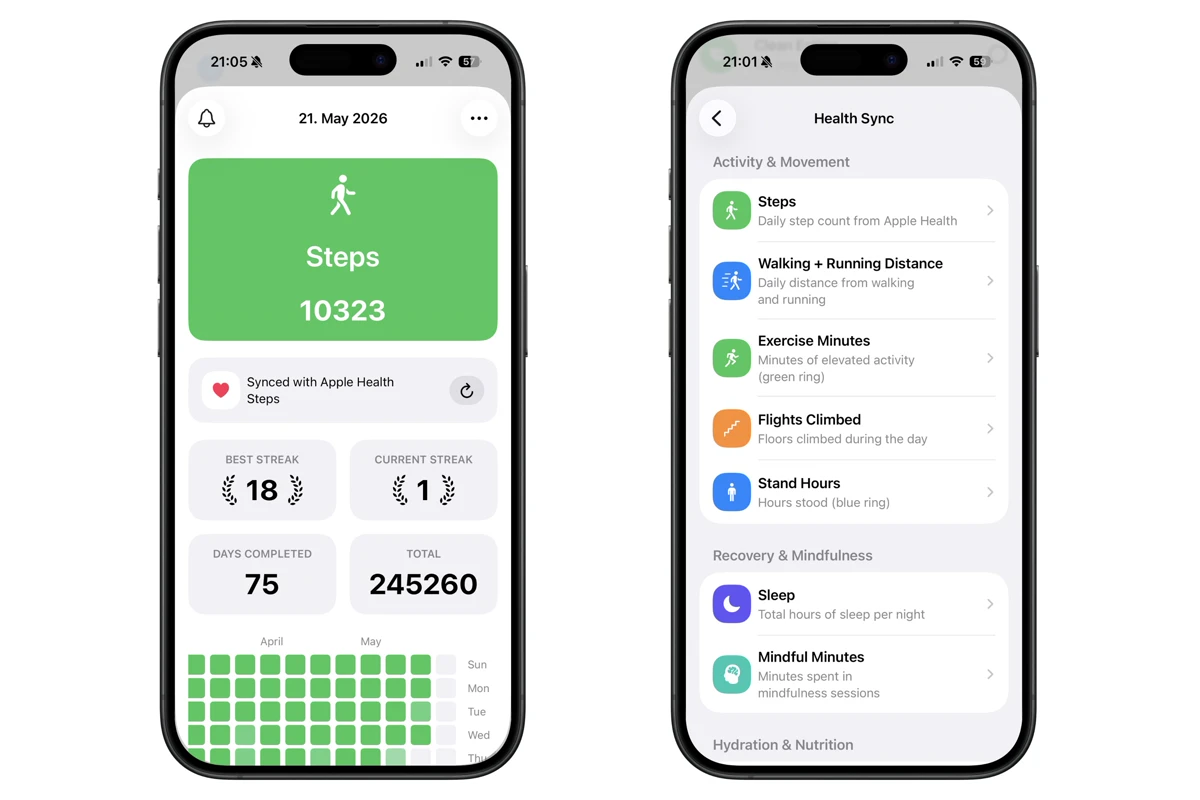
Better can sync Steps from Apple Health, then show the habit as a daily count, streak, total, and grid.
Download Better on the App Store →
Get Better on your phone
That matters because friction is where routines leak. If your phone already knows the step count, your tracker should not ask you to re-enter it at night. Better keeps the habit visible while the data comes from the place you already use.
Build the 10,000 steps around your real day
Most people do not fail a walking goal because walking is complicated. They fail because they imagine one long, clean block of time that rarely appears.
Split the steps instead.
| Part of the day | Simple step plan |
|---|---|
| Morning | 10 to 20 minutes outside before work or after school drop-off. |
| Lunch | A short walk after eating instead of staying at the desk. |
| Afternoon | Walk during one call that does not need a screen. |
| Evening | An easy loop after dinner, even if it is short. |
One long walk can work. Three smaller walks are often easier to keep.
The goal is not to make walking dramatic. The goal is to avoid the moment where you look at your phone at 9:41pm, see 4,800 steps, and realize the day has run out of edges.
Use the grid, not just the streak
A streak is motivating until it becomes fragile.
Better shows streaks, days completed, total steps, and a calendar-style grid. The grid matters because it gives you more than one story. You can see whether walks fall apart on Sundays, whether workdays are easier than weekends, or whether the minimum version is saving the routine more often than you expected.
A single missed target is information. A pattern is more useful.
If you are building a 75-day walking challenge, that grid becomes the point. You are not trying to have one perfect walking day. You are trying to make movement repeatable enough that the green squares start to tell the truth.
Write your minimum version before you need it
A 10,000-step routine needs a backup rule.
Not because you plan to miss. Because real days have weather, work, cramps, travel, bad sleep, late dinners, and people who need you right when you were about to leave.
The minimum version keeps the habit alive without pretending the day was the same as a normal day.
| Day type | Step rule |
|---|---|
| Normal day | Aim for 10,000 steps. |
| Busy day | Hit a planned minimum, such as 6,000 or 7,000 steps. |
| Recovery day | Take an easy walk and keep the streak honest. |
| Travel day | Walk where possible, then record the day as it was. |
Choose your numbers before day one. If you decide while tired, every minimum starts to sound reasonable. If you decide early, the backup becomes part of the routine instead of an excuse.
Add the habits that make walking easier
10,000 steps can stand alone, but it often works better with one or two support habits.
Better lets you track steps next to the rest of the day. That might mean water, reading, sleep, exercise minutes, or a short evening walk. Keep the stack small. The walking rule should still be the main thing.
- Sync Steps from Apple Health so the count updates automatically.
- Pick one default route that takes 10 to 20 minutes.
- Choose the step minimum for busy days before starting.
- Check your step count before evening, not only at bedtime.
- Track the pattern for two weeks before changing the target.
A good routine should reduce decisions. If every walk starts with a debate, the routine is still too heavy.
Do not let one low-step day erase the habit
One low-step day is not the same as quitting.
If you miss because the target is too high, lower the starting point and build up. If you miss because you waited too long, move one walk earlier. If you are inside a challenge, use the miss to decide whether to restart, adjust, or keep going. If the route is boring, choose a new loop. If life was messy, record the day and keep going.
Better is useful here because it does not rely on your mood at the end of the day. The count is there. The grid is there. You can decide what to do next from the pattern, not from the guilt of one imperfect day.
Try a step goal for two weeks before rewriting the whole routine. That gives you enough normal days, busy days, and low-energy days to see what is actually working.
10,000 steps is just a number. The real habit is making movement part of the day before the day disappears. For more movement options, see 75 Soft workout ideas.
Download Better on the App Store →
Get Better on your phone